
PIXOTOPE MOTION
MAKE IT LIVE. MAKE IT UNREAL.
Powered by Unreal's Engine Motion Design toolset Pixotope Motion is the latest addition to Pixotope's range of graphic solutions.
Template based, rundown driven, character generator and motion design platform based on cutting-edge technology, and Pixotope's robust architecture.
Whether you are creating simple lower thirds or complex AR overlays, Unreal Engine provides foundation that's more reliable and more capable than legacy systems.
Built on the same engine powering AAA games and Hollywood films.
Frame-accurate playback, and precision timing that broadcast demands. No more system failures during live shows.

While proprietary systems lock you into expensive upgrade cycles, Unreal evolves continuously. Continuous engine updates deliver new capabilities, and seamless license upgrades unlock VS/AR and XR features instantly—no reinstallation required.

From simple text graphics to photorealistic environments, one system handles everything. No performance compromises whether you're running basic bugs or complex 3D scenarios.

Runs on COTS workstations, not proprietary boxes. Choose your hardware, scale your budget, upgrade when you want. No vendor lock-in, no inflated hardware costs.

Traditional graphics, AR overlays, virtual sets, and XR productions from the same system. One template works across all formats without conversion or recreation.

Excel at everyday broadcast graphics while enabling cinematic quality when stories demand it. Best of both worlds without switching systems or compromising workflow.
PIXOTOPE MOTION
CORE FEATURES
Custom broadcast workflows built on Unreal Engine's Motion Design toolset, designed specifically for professional broadcast environments.
Design
made easy
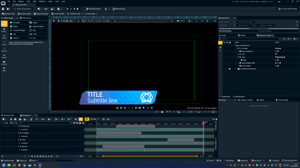
Unreal Motion Design toolset brings the speed and freedom of real-time workflows to everyday 2D design, making motion graphics creation faster, simpler, and accessible to designers of all backgrounds.
Intuitive layer-based tools, familiar animation controls, and smart context-aware behaviors are among the features that help Unreal Motion Design remove much of the technical overhead traditionally associated with Unreal Engine.
Designers can focus on creativity rather than setup, with streamlined workflows for creating 2D layouts, animating elements, and managing key properties directly in the viewport.
Combined with Pixotope’s robust underlying infrastructure, this toolset significantly reduces the time required to build, update, and iterate on motion graphics—empowering more designers to leverage Unreal’s power without needing deep engine expertise.
Property
control
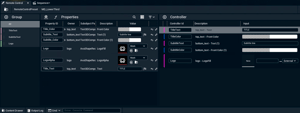
Unreal Motion Design makes it easy for designers to expose the properties they need and control them with flexible, intuitive tools.
Key attributes such as transforms, materials, and custom parameters can be published in seconds without navigating deep Unreal menus.
Once exposed, controllers are used to link and adjust multiple elements at once, making template rigging flexible, and fast.
This streamlined approach removes technical barriers and keeps the focus on creativity, making it faster and easier for anyone to build, animate, and refine motion graphics in Unreal.
Transition logic
and state machines
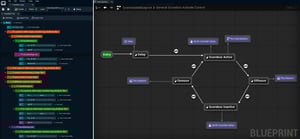
Unreal Motion Design introduces a powerful yet approachable way to manage transition logic via its scene-state machine.
Designers can define clear states for any graphic such as In, Change, and Out and let Unreal handle the logic that moves between them.With simple visual tools, states become easy to build, adjust, and preview.
This visual state-driven workflow removes the need of scripting and blueprinting, allowing designers to update animations or behaviors without breaking the overall flow.
Even the most complex transition logic structures, can be easily created and adjusted with no special previous experience.
Erizos Studio
Integration
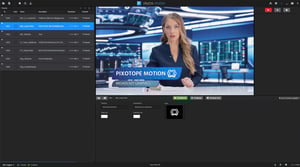
Erizos Studio is the front end for Pixotope Motion. It gives designers and operators a fast, intuitive way to create, manage, and control graphic templates.
Its streamlined workflow makes building templates and assembling rundowns simple, with clear tools for organizing scenes and exposing only the properties needed for live operation.
Data integration is done using an easy drag-and-connect interface, allowing real-time inputs from external data sources to be mapped directly to any Pixotope Motion exposed parameter.
Operators can also customize their UI and add persistent Show Controls to match the needs of each production, ensuring a clean, efficient workspace tailored to their specific broadcast.
The result is a flexible, operator-friendly environment that keeps both design and playback smooth, responsive, and production-ready.
PROVEN
ACROSS BROADCASTING
From daily news to major events, Pixotope Motion delivers the reliability broadcasters demand with the creativity modern audiences expect.
-
Automated rundown integration
-
Breaking news rapid deployment
-
Multi-channel graphics engine
-
Erizos Studio data parsing
-
Social media integration
-
Multi-language templates
- Clip playback
-
Live scoreboard graphics
-
Player statistics overlays
-
Real-time sports data feeds
-
Team comparison graphics
-
Match preview packages
-
IF-THEN-ELSE transition logic
-
Social media highlights
- Real-time result displays
- Candidate information panels
- Erizos Studio polling data
- Historical comparisons
- District-level analysis
-
Real-time result displays
-
Interactive maps with Motion Design
-
Candidate information panels
-
Erizos Studio polling data
-
Historical comparisons
-
District-level analysis
-
Market ticker displays
-
Stock chart integration
-
Financial data parsing
-
Currency exchange rates
-
Company profile graphics
-
Economic indicator displays
-
Social media versions
-
Mobile-optimized graphics
-
Streaming platform formats
-
Web player integration
-
Archive-ready outputs
-
Cross-platform consistency
BREAKING FREE
FROM LEGACY LIMITATIONS
Broadcast graphics technology has stagnated while production demands have evolved.
See how Pixotope Motion compares to what you are using today.
IMMERSE YOURSELF IN OUR VIRTUAL PRODUCTION SOLUTIONS TRY PIXOTOPE TODAY
BOOK A DEMO
FAQs
Pixotope Motion is built on Unreal’s Motion Design system, created from the ground up to lower the barrier to Unreal. It uses familiar creation tools, clear state-based animation logic, and streamlined property controls, making advanced real-time motion graphics fast, intuitive, and accessible to every designer.
Pixotope Motion integrates with your current broadcast infrastructure while delivering real-time 3D graphics, dynamic lighting, and photorealistic rendering.
It supports standard protocols (SDI, NDI, SMPTE 2110) and familiar control interfaces (CII, MOS), so you keep operational efficiency while gaining unlimited creative possibilities that traditional template-based systems can't match.
Your existing graphics operators can master Pixotope Motion in 2-3 days.
Graphics operators that are used to template based rundowns, will find Erizos Studio, our front end, simple to use and intuitive.
For designers, as Pixotope Motion is built on top of the Unreal Motion Design tool set, the interface uses familiar broadcast concepts with template-based workflows.
Designers create sophisticated templates that operators customize with text, data, and branding - just like current systems, but with far greater creative freedom.
Modern GPU-based workstations with NVIDIA RTX 4070 series or higher recommended.
Existing broadcast infrastructure (routers, monitoring, control systems) remains unchanged.
Video I/O card per workstation based on your preferences and needs (AJA, BMD, Matrox).
Pixotope Motion offers Enterprise - grade reliability with full redundancy and automatic failover capabilities.
Major broadcasters worldwide use Pixotope Motion for live sports, news, and events.
It is designed specifically for mission-critical broadcast environments.
Absolutely, Pixotope Motion excels at real-time data integration.
Connect directly to sports statistics, financial feeds, weather data, and election results.
Graphics update automatically as data changes, with zero latency impact.
Template-based data binding makes setup simple while supporting complex visualizations that traditional systems can't achieve.